 WOVEN PLATEAU
The Journey
A Thousand Years in the Making
The Tibetan carpet has traveled a millennium — from the felted mats of nomadic camps to the throne rooms of the Potala Palace, from Silk Road trading posts to contemporary design galleries. Its story is one of continuity, adaptation, and the enduring power of handwork.
Nomadic Beginnings
The earliest Tibetan textiles were felted — wool compressed and worked into dense, insulating mats that served as tent floors, bedding, and saddle pads. Felt-making predates weaving on the plateau and remains an essential craft among nomadic communities to this day. Felt requires no loom, no spinning — just wool, water, pressure, and skill passed from mother to daughter.
The transition from felt to knotted pile carpets likely occurred through contact with weaving traditions along the Silk Road. By the 11th century, distinctive Tibetan knotting techniques had emerged, adapted to local materials and cultural needs. The vertical loom, the continuous-warp knot, and the preference for high-altitude wool all distinguish Tibetan carpets from their Persian, Turkish, and Chinese counterparts.
The Silk Road Exchange
Tibet's position at the crossroads of Central Asia made it a natural conduit for cultural and artistic exchange. Chinese silk brocades brought peony, dragon, and phoenix motifs that Tibetan weavers adapted to wool. Indian Buddhist iconography introduced the lotus, the endless knot, and the eight auspicious symbols. Persian carpet traditions influenced border designs and medallion compositions.
But Tibetan weavers did not simply copy. They transformed these influences into something distinctly their own — bolder in color, freer in drawing, and always rooted in the materials of the plateau. A dragon on a Tibetan khaden does not look like a dragon on a Chinese silk robe. It has been reinterpreted through the logic of wool, knot, and the weaver's hand.
Monastery & Palace: The Golden Age
From the 17th to 19th centuries, Tibetan carpet weaving reached its classical peak, driven by commissions from the great Gelugpa monasteries — Drepung, Sera, Ganden — and the Potala Palace in Lhasa. The Wangden Valley in particular became famous for producing carpets of exceptional quality and distinctive design, characterized by dense knotting, rich colors, and complex mandala-inspired compositions.
Temple runners stretched the length of assembly halls, marking seating for hundreds of monks during prayer. Throne carpets elevated the seats of high lamas. Door coverings and pillar wraps defined sacred spaces. These were not furnishings in the modern sense — they were integral to the architecture of devotion.
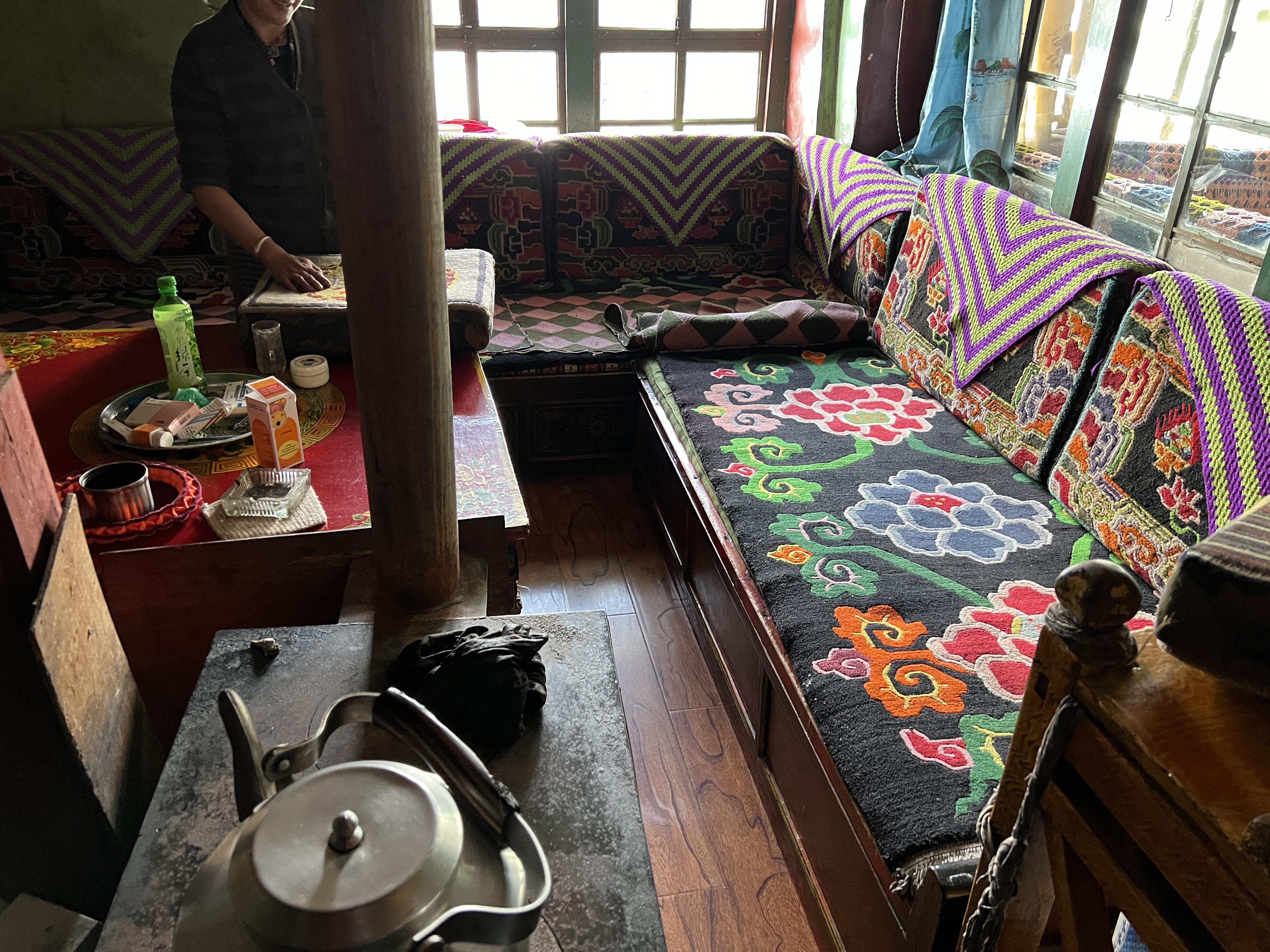
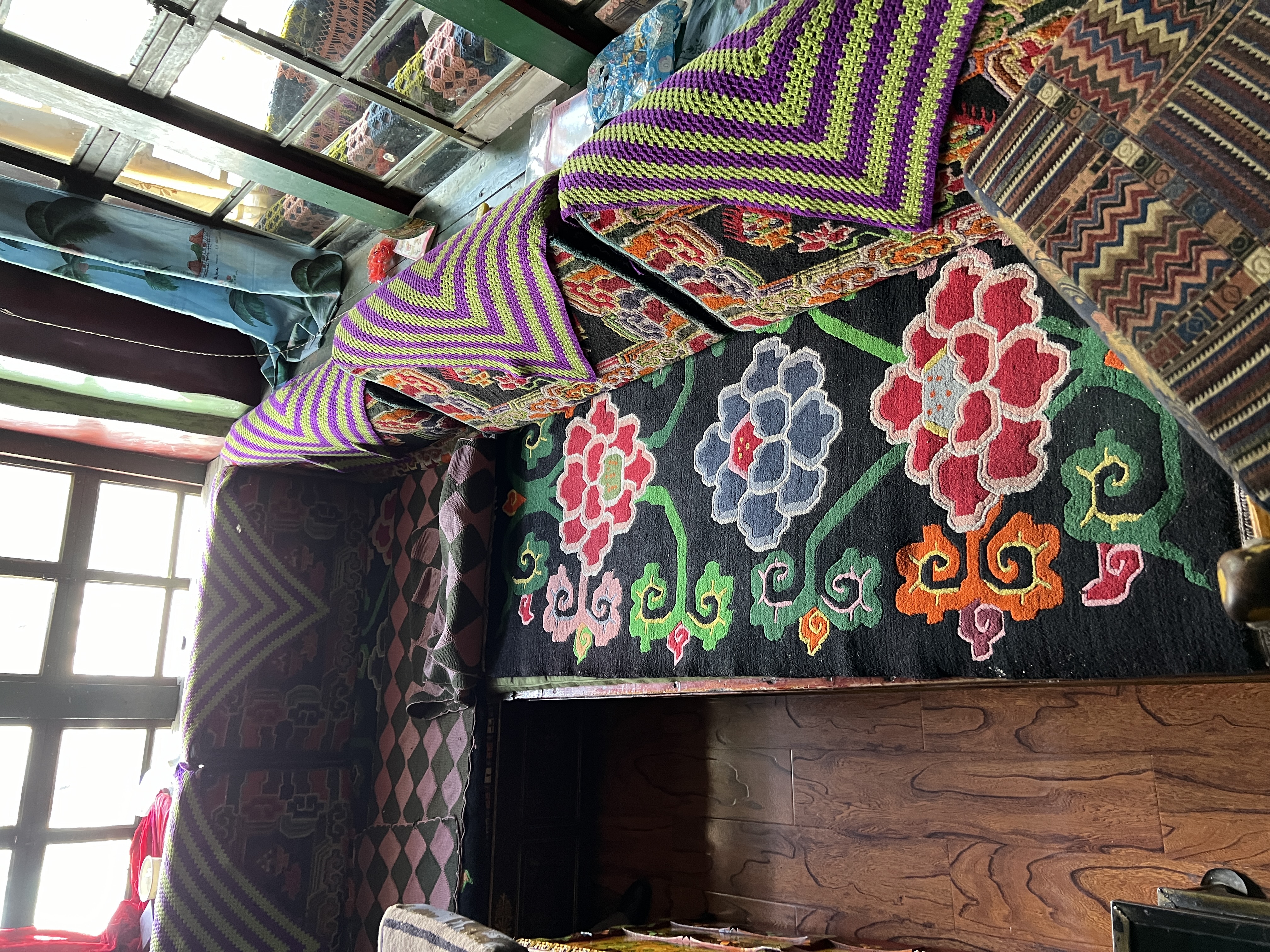
Alongside monastic production, domestic weaving flourished in villages and nomadic camps. Every household had its khaden — the body-scale sitting rug that was the center of family life. These domestic pieces, woven by and for the family, often display a freshness and spontaneity that formal monastic commissions lack.
Decline & Revival
The 20th century brought disruption — political upheaval, the introduction of synthetic dyes and machine-spun yarns, and the decline of the traditional patronage system. Many weaving communities dispersed. Knowledge that had been transmitted orally for generations was at risk of being lost.
But the past three decades have seen a remarkable revival. Young Tibetans are returning to the loom, often combining traditional techniques with contemporary design sensibilities. International collectors and designers have rediscovered Tibetan carpets, drawn by their authenticity, material integrity, and the depth of their cultural narrative. What was once in danger of becoming a museum piece is once again a living craft.
Into the 21st Century
Today's Tibetan carpet exists in two worlds simultaneously: the traditional workshop where techniques unchanged for centuries produce pieces for monasteries and homes on the plateau, and the global design market where Tibetan carpets find new audiences in contemporary interiors. This duality is not a tension — it is a strength. The craft has proven its ability to remain relevant across vastly different contexts because its foundation — exceptional materials, skilled hands, and cultural depth — is timeless.